

Most moving problems start before moving day. A quote that turns out to be an estimate. A crew of subcontractors nobody mentioned. A lift that was never booked.
Asking the right questions before you hire a moving company in Singapore prevents most of this. It takes about ten minutes per mover, and the answers tell you more than a star rating ever will.
Below are the questions worth asking, the answers that should worry you, and the local details general checklists skip, like MCST approval and Town Council lift bookings.
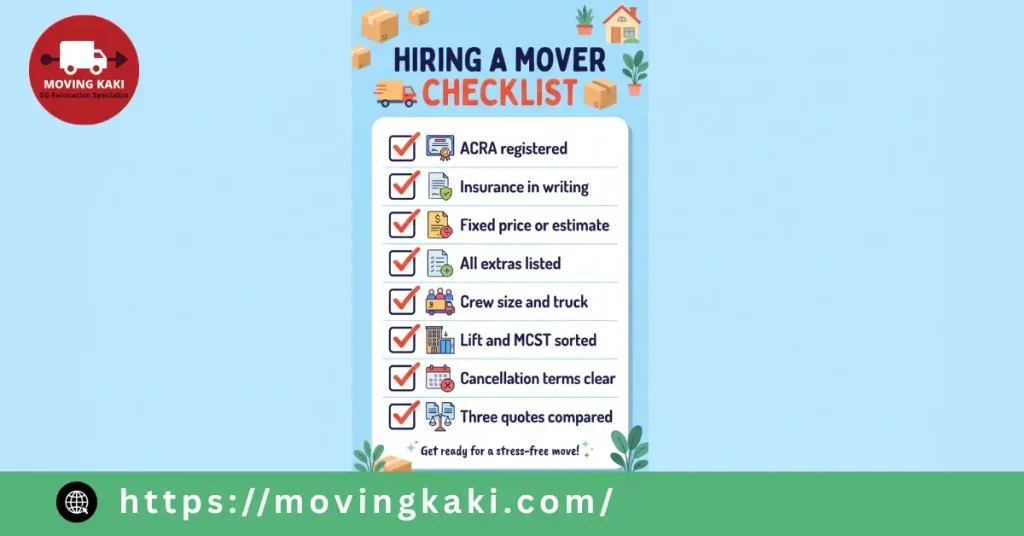
There’s a short checklist near the end. Screenshot it and use it on every call.
Six Questions To Ask Before You Hire A Moving Company
Start here. If a mover can’t answer these clearly on the phone, you don’t need to ask anything else.
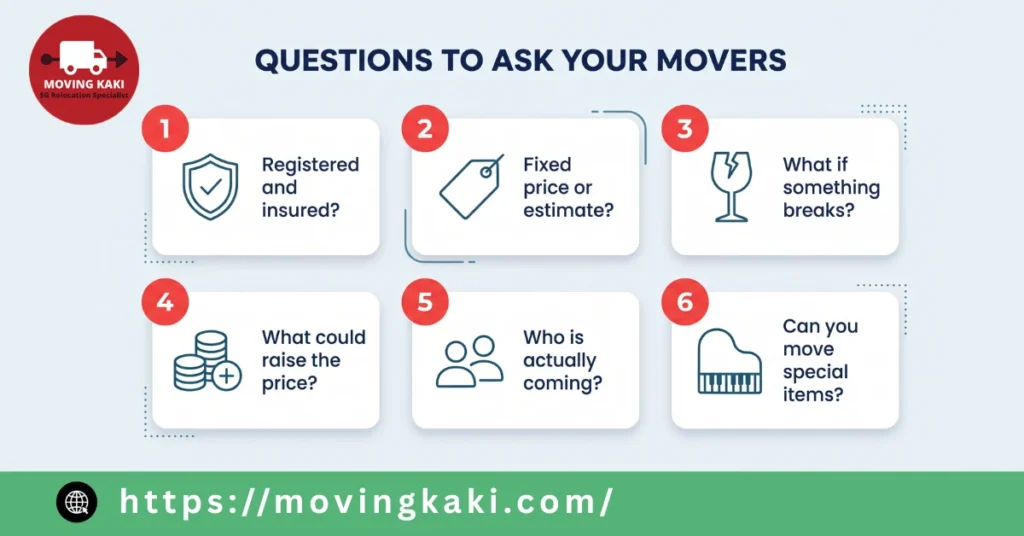
1. Are you registered and insured?
A real moving company is registered with ACRA, Singapore’s business registry. You can look up any company name on bizfile.gov.sg in a few minutes. Their trucks should also be registered goods vehicles with the LTA.
Then ask what the insurance actually covers. Damage to your furniture in transit is one thing. Damage to a lift, a corridor wall or a neighbour’s door is another. Ask for proof of both in writing, not a verbal “yes, we’re covered.”
2. Is this price fixed, or just an estimate?
A fixed quote is the price you pay, as long as the job matches what you described. An estimate is a guess that can rise on the day. Both are normal, but you need to know which one you’re holding before you sign.
If you’re weighing up how movers charge, see our guide comparing hourly and flat-rate movers in Singapore.
3. What happens if something breaks?
Ask whether the cover pays the full replacement value or a capped amount per item. A cap of a few hundred dollars won’t help much if a TV or glass dining table is damaged.
Also ask how claims work. How soon must you report damage? Do they need photos? How long does payment take? A good mover answers all three without hesitating.
4. What could make the price go up?
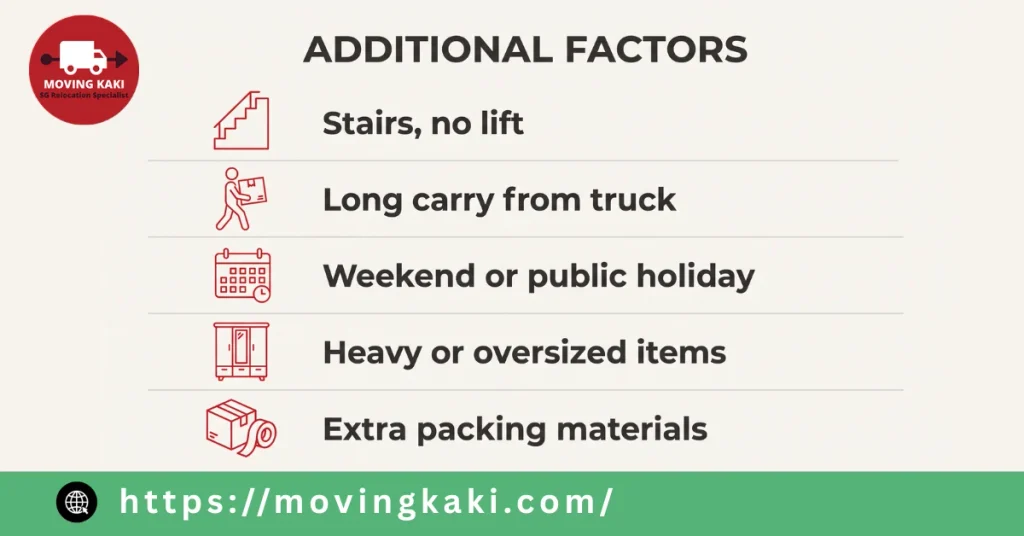
This is the question most people forget. Common extras include:
- Carrying items up stairs when there’s no lift
- A long walk from the truck to your unit
- Weekend or public holiday moves
- Heavy or oversized items like safes and wardrobes
- Extra boxes, bubble wrap or furniture dismantling
Ask for every possible extra charge in writing. If the list is empty, ask again.
5. Who will actually move my things?
Some companies quote the job, then send a subcontracted team you’ve never heard of. That isn’t always bad. You just want to know the team is trained and covered by the same insurance.
6. Can you handle pianos, antiques or other speciality items?
General movers are fine for boxes and sofas. A piano is different. An upright can weigh more than three adults, and a grand piano often has to be partially disassembled to fit through a door.
If you own anything heavy, fragile, or valuable, ask what equipment they use and how often they move it. Ask to see photos of past jobs. For pianos specifically, use specialist piano movers in Singapore who bring piano boards, straps and the right number of people.
Questions About How The Move Will Actually Run
Once the basics check out, these questions tell you how organised the company really is.
Do you need to see my home first?
A quote given without a site visit or video call is a guess. Movers who want to see your home are trying to price the job properly. Ask whether the assessment is free, and whether the quote changes if they find more than you listed.
Will my things be wrapped and protected?
Ask exactly what’s included. Blankets for furniture? Bubble wrap for glass? Shrink wrap for mattresses and sofas? Some movers include basic materials and charge for the rest. If you’d rather not pack at all, ask whether they offer professional packing and unpacking services.
Can you take away things I no longer want?
Most moves turn up an old mattress or a broken shelf nobody wants to bring along. Ask whether the mover can remove these on the same day and what it costs per item or per load. Moving Kaki handles this through its furniture and bulky item disposal services.
What’s your cancellation and rescheduling policy?
Key collection dates keep slipping in Singapore. Ask how much notice you need, whether the deposit is refundable, and what happens if you need to change the date twice.
How many movers and what size truck will I get?
“Enough people” isn’t an answer. Ask for numbers. A crew that’s too small turns a four-hour job into an eight-hour one, and you pay for that at an hourly rate.
Is the crew experienced with my type of move?
Home moves and office moves need different skills. A family move is about caring for personal items and getting bedrooms usable by night. An office move is about keeping downtime short, moving servers and computers safely, and often working after hours or over a weekend.
If you’re relocating a business, ask about IT equipment handling, labelling systems and whether they’ve moved offices your size before. Our team of office movers in Singapore plans these jobs around your business hours.
Singapore Details Most Moving Checklists Usually Miss
Generic moving advice is written for houses with driveways. Singapore homes have lift lobbies, management offices, and carpark rules, and any one of them can hold up a move if you don’t sort it out early.
Lift booking for HDB and condo moves
Many blocks ask you to book the service lift in advance, sometimes with a deposit. For HDB flats, this usually goes through your Town Council. Ask the mover whether they arrange it, whether you need to, and whether they bring lift padding to protect the walls.

MCST approval for condos
Condos are run by an MCST, the estate’s management committee. Most set fixed moving hours, require a refundable deposit, and need a move-in form before the date. Some don’t allow moves on Sundays. Here’s how to get MCST approval when moving into a condo in Singapore.
Parking for the moving truck
A 15ft or 24ft truck may not fit in a normal carpark lot, and some estates require a temporary permit or a loading bay booking. Confirm who handles this. Parking a truck two blocks away adds time and often a long-carry charge.
Free bulky item removal, before you pay for it
Some Town Councils collect a few bulky items free or for a small fee. Check yours before paying a mover to take away an old sofa. Worth reading our step-by-step guide to disposing of bulky items in Singapore first.
Book earlier during peak periods
Year-end, the June school holidays and the last weekend of each month fill up fast. For a normal date, 2 to 4 weeks ahead is usually enough. For peak dates, book 4 to 6 weeks ahead. If your dates are flexible, see our guide on the best time to move house in Singapore.
How To Check A Mover’s Reviews And Track Record
Choosing a moving company in Singapore comes down to one habit: checking what the company says against what its past customers say.
Start with Google reviews, but read them properly. Ignore the overall score for a moment and look for patterns. Do several people mention the same crew member by name? Does the same complaint about late arrivals keep coming up? Recent reviews matter more than ones from three years ago.
Read the bad reviews too, and look at how the company replied. A calm, specific reply that explains what went wrong is a good sign. No reply, or an argument, is not.
A few more checks take only minutes:
- Look up how long the company has been registered on bizfile.
- Ask friends or colleagues who moved recently which mover they used, and whether they’d use them again.
- Look for real photos of the crew and trucks on their website or social pages, not just stock images.
Reliable movers in Singapore are usually easy to verify. If you can’t find much about a company at all, treat that as an answer.
Signs Of A Bad Moving Company
Some warning signs are obvious once you know what to look for. Walk away if a mover:
- Asks for a large deposit before doing any work
- Has no business address, no ACRA registration or no genuine reviews
- Gives vague answers about insurance, pricing or who is coming
- Quotes far below everyone else without explaining why
- Won’t put the price and inclusions in writing
A very low quote usually means something is missing. That might be insurance, packing materials, enough crew, or simply an honest final bill. Before you sign anything, read our guide to red flags in moving contracts.
Good signs are the opposite. Look for clear written quotes, staff who answer questions without getting defensive, and reviews that sound like real people.
How To Compare Moving Quotes Properly
Get at least three moving quotes. Fewer than that, and you have nothing to compare.
The trick is making sure you’re comparing the same job. Line the quotes up side by side and check that each one covers:
Don’t automatically pick the cheapest. The middle quote is often the safest choice, because it tends to include what the cheapest one quietly leaves out.
Conclusion
You decide on a good move mostly in the week you choose your mover, not on the day itself.
The questions to ask before hiring a moving company all lead back to one thing: getting every promise in writing. Registration, insurance, price, extras, and the people coming to your door. Add the Singapore checks on lifts, parking, and MCST rules, and you leave very little to chance.
If you’d like a mover who answers all of this upfront, our house movers in Singapore start every job with a free onsite assessment and a written quote.
Frequently Asked Questions
How far in advance should I book movers in Singapore?
Two to four weeks is enough for most moves. Book four to six weeks ahead if you’re moving at year-end, during the June school holidays or on the last weekend of a month. Those dates fill up first, and booking late can leave you with only the movers nobody else picked.
Is tipping movers customary in Singapore?
Not really. Labour is already in the price, so nobody expects a tip. A small amount for a hard-working crew, or cold drinks on a hot afternoon, is still appreciated.
What items will movers refuse to transport?
Movers almost always refuse gas canisters, lighter fluid, and other flammables. So are live plants, pets and perishable food. Many movers also won’t carry cash, jewellery or important documents, and you shouldn’t want them to. Keep those with you on the day.
Can I move some items myself to save money?
Most movers are happy with a split move. You take the small boxes and fragile bits in your car; they handle the furniture and heavy items. Tell them when you book, because it can change the crew size and lower the quote.
Do I need to be home during the move?
Someone should be. The crew will have questions about what goes where, and you’ll want to check for damage before they leave. If you can’t be there, a trusted family member or friend can stand in, as long as they know the plan.


